A bit of background, I have been learning shillelagh (bataireacht) for more than a decade and I have been lucky enough to meet and train with folks from the Doyle system, Antrim Bata, and even smaller systems like Rourke and Keegan bata. I leapt at the chance a few years ago to participate in the growing revival of Collar and Elbow wrestling, having a bit of experience through the stick grappling of bataireacht. I have competed at Tom Higgins’ Wrestling Wars and in the Midwest Collar and Elbow championships. I love martial arts and I love Irish culture.
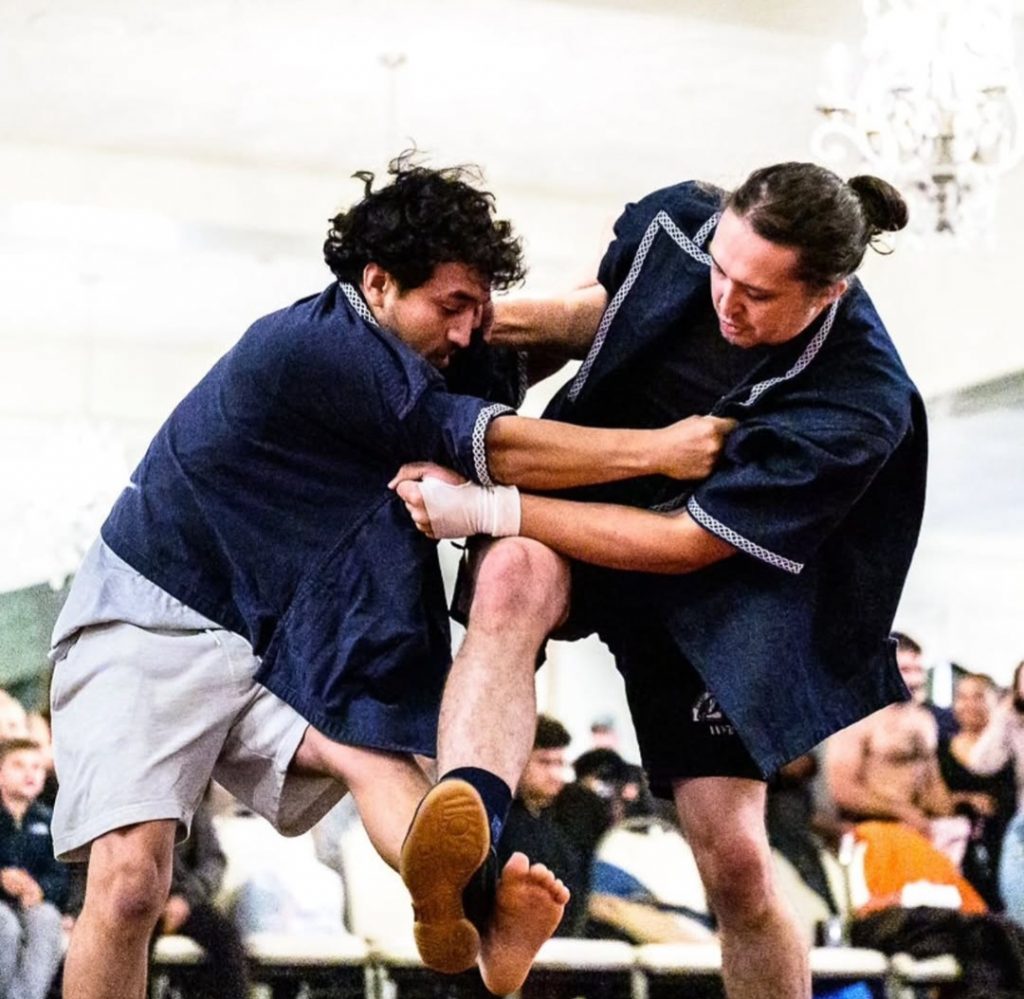
These things are very important to me and I am happy to contribute to their growth. But one thing has been looming on the horizon. As living arts like bataireacht gain popularity and nearly dead arts like Collar and Elbow are revived, we will see people latch onto it who have bad intentions. These are white supremacists, Christian nationalists, and misogynists. In reality all of these groups are connected, by a worldview that centers the European man as both the norm and peak of human existence.
I have already heard of white supremacists moving into our martial arts as an alternative to Asian martial arts such as karate, muay thai, kung fu, and jiujitsu. The idea of this is both blood curdling and laughable. Irish Martial Arts, at least in the ‘modern’ era, have always stemmed from anti-imperial action and Irish people were not even considered properly “White” when these arts developed. Shillelagh have been a tool of anticolonial practice since time immemorial, but became especially practiced when the British crown instituted anti-Catholic penal laws in the eighteenth century. These, among other things, limited what weaponry could legally be carried by Irish peasantry. Irish resistance on the island and in the Diaspora has often made use of Irish martial arts from boycotts and strikes, to battles and revolution.
Yet, now that we Irish and Irish Diasporics are part of a ‘white’ majority, we have hateful fascists attempting to worm their way into our practices. This is not to say that Irish people have not been participants in imperialism and oppression. I could write a whole book on that issue alone. But Irish people, on the whole, see themselves in the eyes of the oppressed, not the oppressor. The same Black and Tans that devastated communities in British-held Ireland were sent to suppress the native Palestinian population as Israel was being developed. Our Irish ancestors were supported through the famine by Indigenous American nations, and now Irish people seek to help these same nations. When Oswald Mosley and his fascist brigade intended to walk into the East End and terrorize Jews, it was Irish Catholics, labor organizers, and dock workers that fought back to defend their Jewish neighbors. Hell, look up the story of the Batallón de San Patricio (St. Patrick’s Battalion). James Connolly once said, “Let no Irishman throw a stone at the foreigner; he may hit his own clansman. Let no foreigner revile the Irish; he may be vilifying his own stock.”
This kind of class consciousness and understanding of culture, race, and gender is not particularly Irish, but must be applied to our Irish practices. As we have always been revolutionary peoples, there have been women, people of color, and queer folks always a part of that Irish revolutionary process. This is true, even when they were pushed aside or silenced when it became convenient. For example, think about the women who were organizers in the Easter Rising. Some were pushed to the side, and some were able to continue influencing Irish politics. This means, when racialized hate is brought into our spaces, we have to fight it back, just like our ancestors. And we have to stick to our guns, even when it isn’t convenient. We cannot abandon our principles and our families. White supremacy has no place in our gyms, just like our homes.
So what kind of white supremacy issues am I warning about?
The white supremacist is desperately clinging to an identity that doesn’t truly exist: the alpha male, the cis-white man, the unbeatable warrior. These are all constructed identities built to sell a particular existence. Our modern concepts of race didn’t exist until European aristocrats had to ‘scientifically’ prove why they could commit genocidal behaviors against the Irish, Africans, Arabs, Native Americans, and more. This constructed perfect man, in Western society, is built around ideas of biological determinism, and intentionally leaves out large parts of the population. It is built to say only a physically strong, emotionally distant/violent, and misogynistic man is meant to be in charge. It is a characterization of the genocidal imperialism that has caused so much harm in the past 500 years. A human equivalent to the dying, flailing, hateful whims of the ruling class. It intends to be an unachievable model. It is built to isolate us and separate us into easily controllable castes.
Patriarchy, and the aristocracy of capitalist countries, requires extreme violence to maintain what is an unnatural system. And so the only way to do this is to indoctrinate young men and women into enacting that violence on each other. So we have these concepts like race to separate us and excuse our violence. The goal is to subjugate people you do not like through structural and physical violence. We see this white supremacy actively evolving in our government affairs, but it also has vanguard groups, such as the KKK and the National Youth Front. Active recruitment is key to maintaining structural power. Whiteness is not indicative of a particular culture or country. It is an amorphous idea that is used to brainwash and belittle. Whiteness did not always apply to Gaelic people. To quote Noel Ignatiev, “Whiteness is not a culture . . . Whiteness has nothing to do with culture and everything to do with social position . . . . Without the privileges attached to it, the white race would not exist, and the white skin would have no more social significance than big feet.” Whiteness exists as a conveyor of privilege, and in an increasingly destitute society where we can’t access basic needs, that Whiteness can be enticing to many desperate for meaning and power. Irishness, on the other hand, is not a single idea or identity.
We are a mixed people with connections to Spain, the Caribbean, America, and beyond. Even before the Diaspora, Ireland was a place with constant migration. This is not to say Ireland is some special melting pot, only to say we are thankfully not a people that can fit the mold of white supremacy, even when some of our own seek to further such disgusting ideas.
Where do fantasists fit into this?
There is no ‘pure’ Irish art, just as there is no pure British art or French art. All of these methods have been influenced by the empires and trade of European society. But you may soon see people selling courses in Scáthach spear or Finn’s stick, as if they hold some unbroken line to the ancient methods of the early Gaels. But those would be fantasies. This is part of a constant trend in culture where people reimagine the past to fit their ideas of what their ancestors would be, instead of the more complicated truth. This occurs on all sides of the political spectrum, but we’re seeing it especially in the political right and the manosphere with Rome, England, Ireland, the Vikings in general, etc.
It’s not wrong to take interest in your history; I highly recommend doing so. But there is a difference between loving your culture, and the dedicated ranking and separation of European culture (and therefore people) as ‘above’ other arts. Isolating a culture above others requires half-truths and bold faced lies to explain how that culture is somehow so much better. For example, let’s look at the rise and fall of Japanese martial arts.
At the turn of the 20th Century, the Japanese government actively utilized mythology and revisionist Budo ideology to help indoctrinate the populace into nationalism. Repackaged stories of honor-bound samurai and lords descended from the gods of the islands (sound familiar, Rome?). Arts like swordsmanship and jiujitsu, which were more connected to the majority ethnicity, were elevated over arts like karate, which came from Ryukyuan practice of Fujianese arts. And those minority arts are absorbed and repackaged in a way that fits the whims of the majority government. The practices of the country, including the martial arts of the country, became a part of a kind of secular national religion. This helped fuel the imperial goals of the government and laid the groundwork for one of the most brutal and destructive periods of colonization recorded (not that the American Empire is any better).
But once Japan lost, its arts continued to spread. And I readily admit that many of these arts are excellent. I love practicing Judo, and have deep respect for Sumo, Kendo, and Okinawan arts like Karate. But what happens when these arts are repackaged for general consumption? The same thing that happens to any art: the myth of supremacy breaks on contact. When an art is not propped up by mythology, it has only its practitioners. The reality is, there is no ultimate martial art just like there is no ultimate group of people. Judo rocks, but it is no better than folkstyle wrestling and vice versa. Yet the mythology and aesthetics are hold overs from the imperial period, so it becomes easy for these arts to develop abusive and cult-like practices. This happens a lot in kendo, whose focus on samurai aesthetics can encourage coaches to abuse their students and students to permanently damage themselves for a sport. Karate has this issue as well, and then there are the magic sellers. There are arts like George Dillman’s “Ryukyu Kempo” which blend the mythology of the ninja, the samurai, and the verbal preparation of a Pentecostal preacher to convince students that they can achieve no-touch knockouts.
I use these examples because they show the dangers of what fantasy can do to a martial art, even when the traditional structures that uphold these fantasies have been weakened or broken. The social structures that develop within a school around these fantasies can become just as powerful to those people.
So what examples do we have of white supremacists attaching themselves to a martial art? And what tactics have worked against them?
Historical European Martial Arts (HEMA) has been dealing with this issue for well over a decade now. While there have been great strides in the broader HEMA community, there are even now active clubs connected to some HEMA gyms in the United States. These are private clubs built with the intent to train white men and indoctrinate them into a violent, radicalized ideology of white supremacy and misogyny. We see this as well in Brazilian Jiu-jitsu. BJJ has always had a fascism issue, but it has exploded with teachers and practitioners such as Jake Shields, Renzo Gracie, and Bryce Mitchell. No martial art is more connected to white supremacists and black pill groups than Brazilian Jiu-jitsu.
The gyms that have fought back against these issues with a few tactics. The first is to make the space unappealing to such hateful people. Many HEMA gyms have found that by openly displaying a Pride flag does a surprising amount to stop chuds from showing up. Having a woman coach classes also tends to keep the wrong kind of people from hanging around. And not just a “women’s class,” even though those can be important to have. If a man can’t take instruction or direction from a woman, he doesn’t deserve further access to your art.
If you hear people say things that seem off, or just down right hateful, you have a duty to call them out on it. You can do this in a few different ways. The simplest is, you can just tell them to fuck off. Secondly, you can play dumb and pretend you don’t understand. Watch them flounder to explain. This often shuts down the issue in the moment and helps the other people there feel comfortable speaking out. The third is for those people you think may just be uninformed and can make a change. That is to say something that brings the attention back to class and then talk to them more in depth later. You can say something like, “Hey that concerned me, what you said, and I don’t know if you intended that,” and then move into a conversation. Because we are raised in a racist society, all of us have racist ideologies taught to us even inadvertently. It is up to us to change that, but we can also encourage others to do the same.
If white supremacists are actively attempting to take space, you can tell them to leave. They have no right to your practices. You don’t have to work with them and you don’t have to train under them. If you find out there’s a bataireacht teacher in your neck of the woods, but find out they’re a piece of shit, you have other options! There are plenty of great Irish martial arts teachers out there and if you can’t train with me, I recommend Strange Fox Fighting Arts and The Rambling Kern.
If you want to learn more about the complexity of Irish history and resistance, but aren’t sure where to start, here’s some recommended readings. These discuss Irish martial arts, Irish history, and our resistance to and our assistance in oppression:
Irish Gangs and Stick Fighting: In the Works of William Carleton – John W. Hurley
Fighting Irish: The Art of Irish Stick-Fighting – John W. Hurley
How the Irish Became White – Noel Ignatiev
In Search of Ancient Ireland: The Origins of the Irish from Neolithic Times to the Coming of the English – Carmel McCaffrey and Leo Eaton
Rot: An Imperial History of the Irish Famine – Padraic X. Scanlan
There Will Be Fire: Margaret Thatcher, the IRA, and Two Minutes That Changed History – Rory Carroll
Do Penance or Perish: Magdalen Asylums in Ireland – Frances Finnegan
Republic of Shame: Stories from Ireland’s Institutions for ‘Fallen Women’ – Caelainn Hogan
Ireland Before the Famine, 1798-1848 – Gearóid Ó Tuathaigh
The Lost Gaeltacht: The Land Commission Migration – Clonbur, Co. Galway to Allenstown, County Meath – Martin O’Halloran
The Beat Cop – Michael O’Malley
The Sons of Molly Maguire – Mark Bulik
The Irish in the American Civil War – Damian Shiels
Ulster to America – Warren R. Hofstra
Embracing Emancipation – Ian Delahanty
Leave a Reply